PRE-LAUNCH PROGRAM CONCEPT · SUBJECT TO ISSUER APPROVAL, BOND COUNSEL REVIEW, AND PROGRAM UNDERWRITING
For residential developers

Quit paying impact fees out of your pocket.

Your capital belongs in dirt and sticks, not in a receipt from the city 18 months before your first closing.

Do you qualify? Three numbers tell you.

If your project clears the three numbers below and fits one of the project types, it is worth fifteen minutes to apply. Qualification is the program's review before your project goes to the public agency.

1–50 Lots or Units
Small projects are the point, not the exception.
$40,000 of Fees
That's the whole entry bar — roughly the average impact fee bill for one new California home (the Franchise Tax Board estimated $33,500 in 2019; about $40,000 in today's dollars). One house can clear it. Your agency may set its own floor.
Residential Projects
Subdivisions, infill, townhomes, ADUs, lot splits, missing-middle, and mixed-use with a residential component.

Start the application   Estimate your fees first

Project types

If you're building housing, you probably fit.

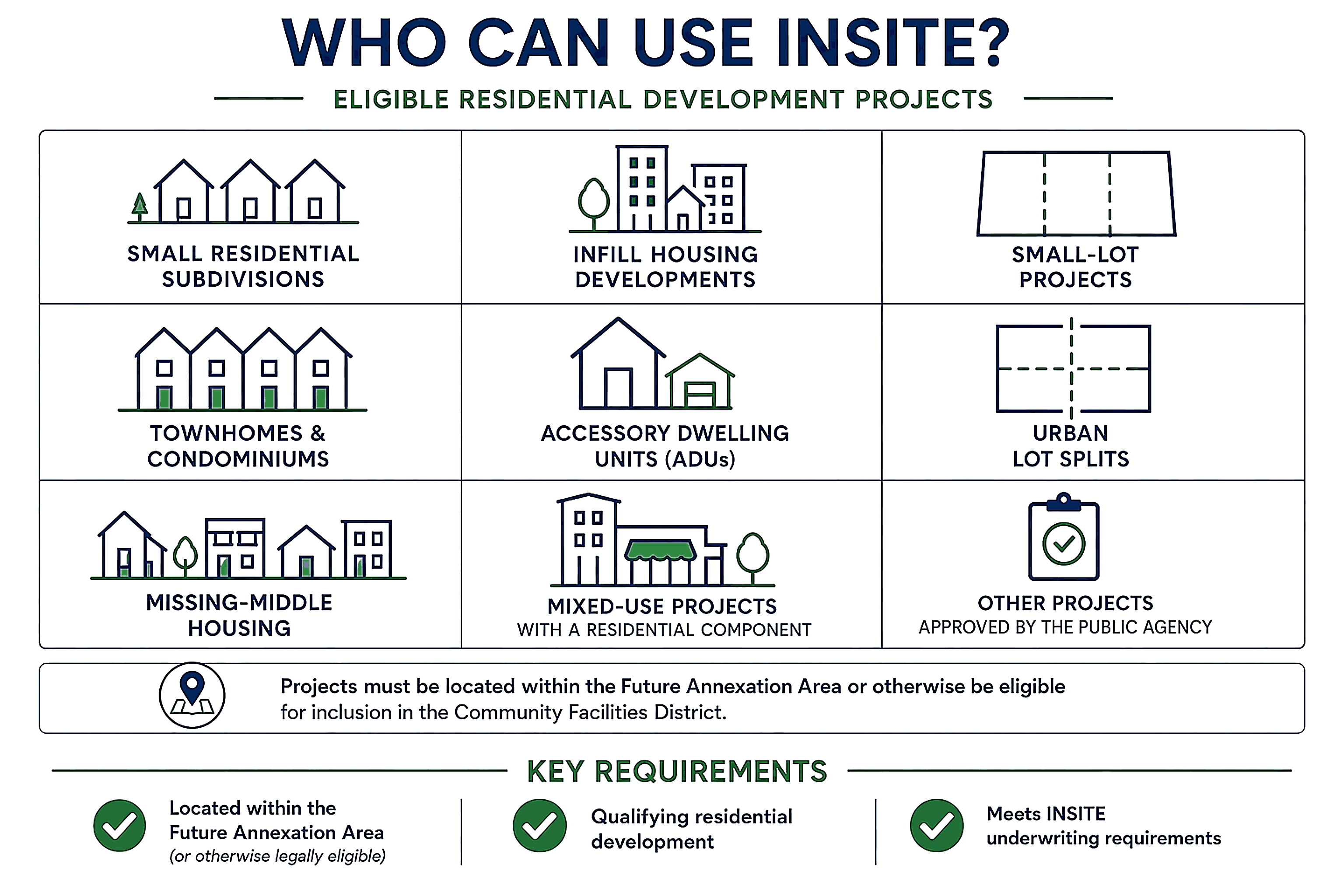
Eligible residential development projects: small residential subdivisions, infill housing developments, small-lot projects, townhomes and condominiums, accessory dwelling units, urban lot splits, missing-middle housing, mixed-use projects with a residential component, and other projects approved by the public agency. Projects must be located within the Future Annexation Area or otherwise be eligible for inclusion in the Community Facilities District.
Location requirement: the project must sit within the Future Annexation Area of a participating agency's Community Facilities District, or otherwise be eligible for inclusion. Not sure? Apply anyway; that check is our job, not yours.
What we look at

Five things, and you already know all five.

No new paperwork exists here. Every item is something your lender or your building department has already asked you for.

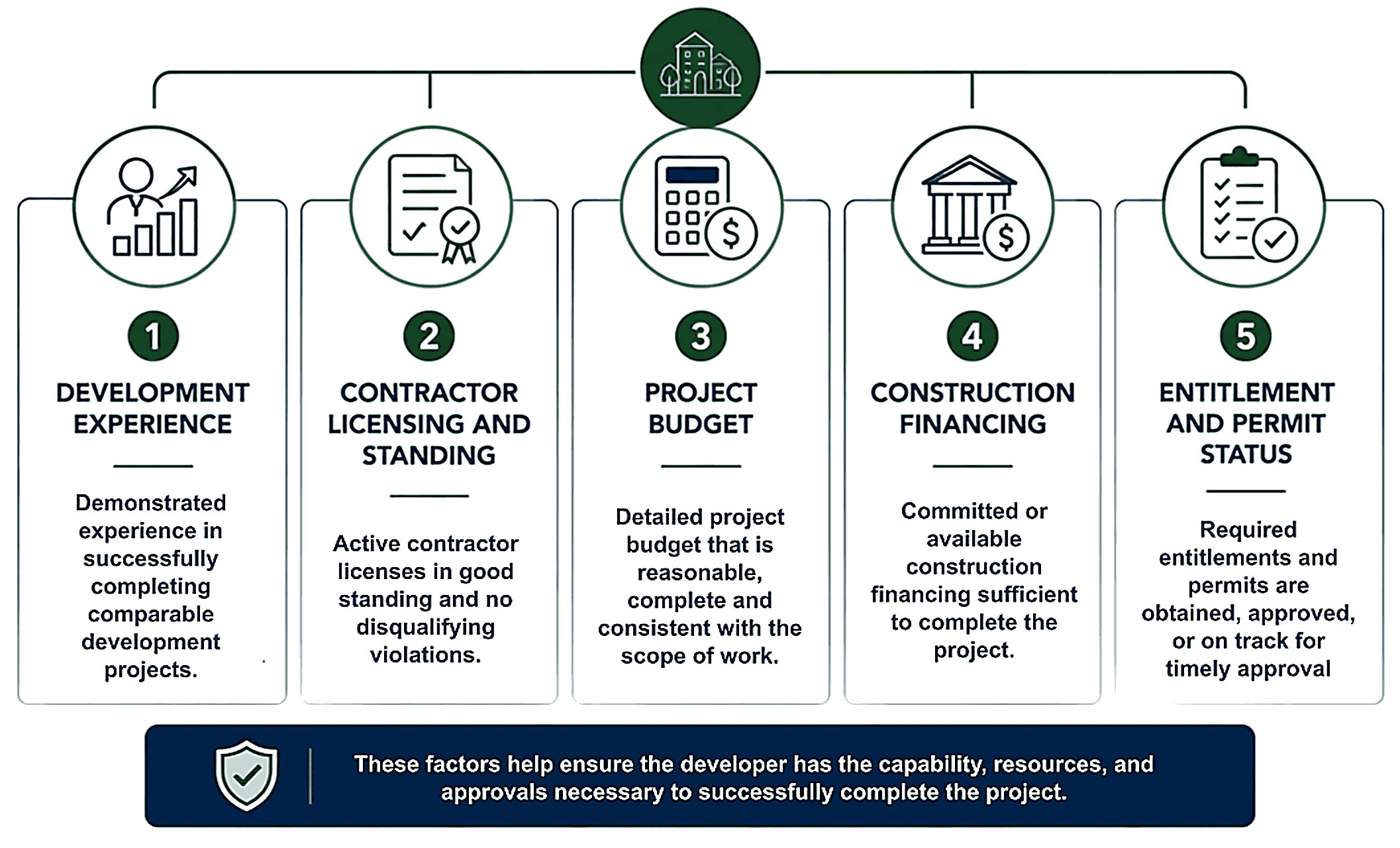
Five developer capacity factors: 1 development experience, 2 contractor licensing and standing, 3 project budget, 4 construction financing, 5 entitlement and permit status. These factors help ensure the developer has the capability, resources, and approvals necessary to successfully complete the project.
Underwriting methodology

How INSITE sizes the amount per parcel.

Two constraints drive every underwriting decision: the finished lot value of the home being built, and the total annual property tax burden the parcel can carry. Together they cap how much of the fees a parcel can support.

Constraint 01

Finished lot value

The finished lot is typically worth 20% to 30% of the finished home value. A $1,000,000 home implies a finished lot value between $200,000 and $300,000. That lot value is the collateral floor the amount is sized against.

Once the finished lot value is determined, the amount available is sized at one quarter (25%) of that lot value.

Constraint 02

The 2% effective tax ceiling

The combined annual property tax burden, meaning the general 1.125% ad valorem, any existing assessments, and the new INSITE assessment, should not exceed 2% of home value per year. INSITE underwrites the new assessment to a rule of thumb of 0.50%, leaving headroom under the cap.

After Constraint 01 and Constraint 02 are both calculated, the lesser of the two amounts is the amount available per parcel.

Per-parcel calculator

Estimate the amount available per parcel.

Plug in your project assumptions. The calculator applies both the finished-lot-value collateral floor and the 2% total tax cap to size the supportable amount per parcel.

Inputs

Program range: 1 to 50
Assumptions
Finished lot value: 20% to 30% of home value.
INSITE new assessment rate: 0.50% of home value per year.
30-year tax assessment basis at 5.75%.

Results

Fees paid per parcel
$0
Lesser of Constraint 01 and Constraint 02.
Total for the project
$0
Across 0 parcels.
Finished lot value
23% of finished home value
$0
Lot-based amount (25% of lot)
Constraint 01
$0
Tax-supported amount
Constraint 02, 0.50% assessment, 30 years
$0
Annual assessment per parcel
Amortized over 30 years
$0

Illustrative only. Final sizing depends on issuer policy, market conditions, debt-service coverage, and reserve requirements.

Read the fine print you'd want us to read to you. The land-secured path is not free money: it shifts the fee cost into an annual special tax that the project's future homeowners pay over the note term, and you pay it yourself on any lot you still own each year. The sizing above shows exactly what that annual assessment is. Values marked as targets or founder estimates are not commitments.

The fine print, in plain words

Two things to know before you apply.

Ownership. You need legal title, contractual authority, or the written consent of every required property owner. If you're in escrow, that can work; tell us where you stand.
Qualification is not a commitment. Qualifying means your project passes the program's review and goes to the public agency. Final participation depends on agency approval, completion of the required legal proceedings, satisfaction of program requirements, and availability of capital. Nobody can promise you the money before those happen, and anyone who does is selling you something.
What gets paid: eligible public development impact fees, plus certain acquisition and incidental costs where the CFD formation documents, the public agency, and applicable law allow it. School facilities fees are excluded at program launch.

Clear the three numbers, fit a project type, own your dirt. That's qualification.

Apply now   Back to the developer page