Build the houses. We'll handle the impact fees.
California residential projects, 1 to 50 lots. Three answers, then the application.
How do I get the money?
You don't get a check. You don't need one. When your permits are pulled, INSITE pays the eligible impact fees straight to the city. No draw schedule, no monthly payment, and the project's deal costs are rolled into the tax roll at origination. Your day-one cash on fees: zero.
How does it get paid back?
It attaches to the dirt, not to you. Each lot carries one line on its property tax bill. While you hold a lot, you pay that line on that lot. When the lot sells, the line goes with it. You never write a payoff check.
| County general levy | as assessed |
| INSITE special tax | set at formation |
| Other district charges | as assessed |
What's the process?
Tell us about your project
The short application: who you are, where the lots are, what the city charges. Ten minutes with your fee schedule in hand.
Sign and build
We underwrite, you sign, and the fees are paid when permits are pulled.
Example: 10-lot residential subdivision
A developer constructing a 10-lot subdivision with approximately $250,000 of eligible public fees can have those costs paid through INSITE rather than paying them upfront.
Repayment occurs through the county property tax roll and generally transfers with the property upon sale. The amount is secured by the property's Special Tax and paid back over the term. This preserves working capital for land development and home construction while reducing reliance on higher-cost construction capital. School fees are excluded at launch.
Your effort, our effort
YOU
- Complete the short application
- Send the city's fee estimate
- Sign the participation agreement
INSITE
- Underwrite the project and the collateral
- Handle the district paperwork
- Pay the fees at the permit counter
- Administer the tax roll each year
Ready when your fee schedule is.
Pull your city's posted fee schedule, then start the application. Want your numbers first? The estimator takes two minutes.
Or estimate your project's fees first.
Quit paying impact fees out of your pocket.
Your capital belongs in dirt and sticks, not in a receipt from the city 18 months before your first closing.
Do you qualify? Three numbers tell you.
If your project clears the three numbers below and fits one of the project types, it is worth fifteen minutes to apply. Qualification is the program's review before your project goes to the public agency.
If your project clears the three numbers below and fits one of the project types, it is worth fifteen minutes to apply. Qualification is the program's review before your project goes to the public agency.
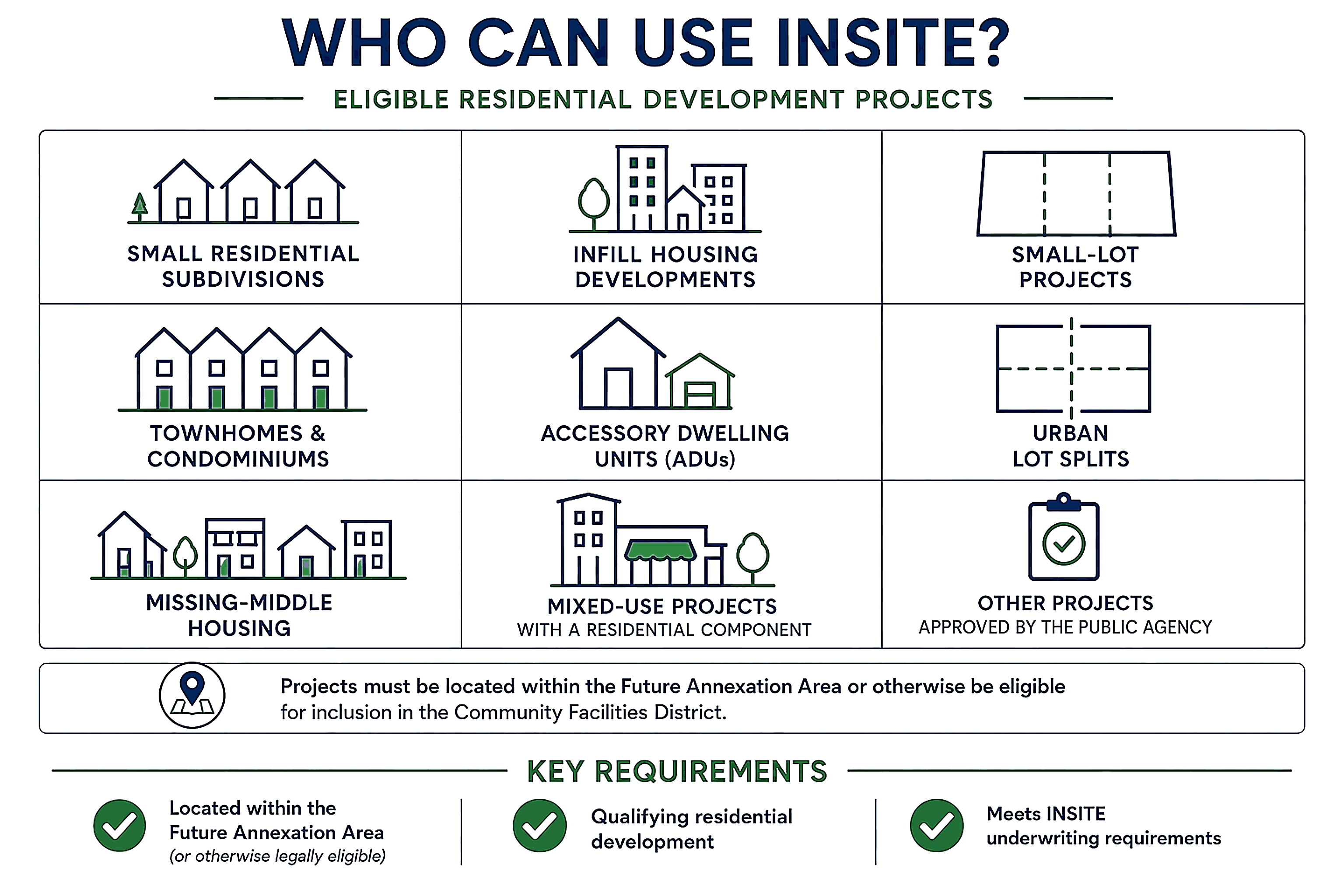
If you're building housing, you probably fit.
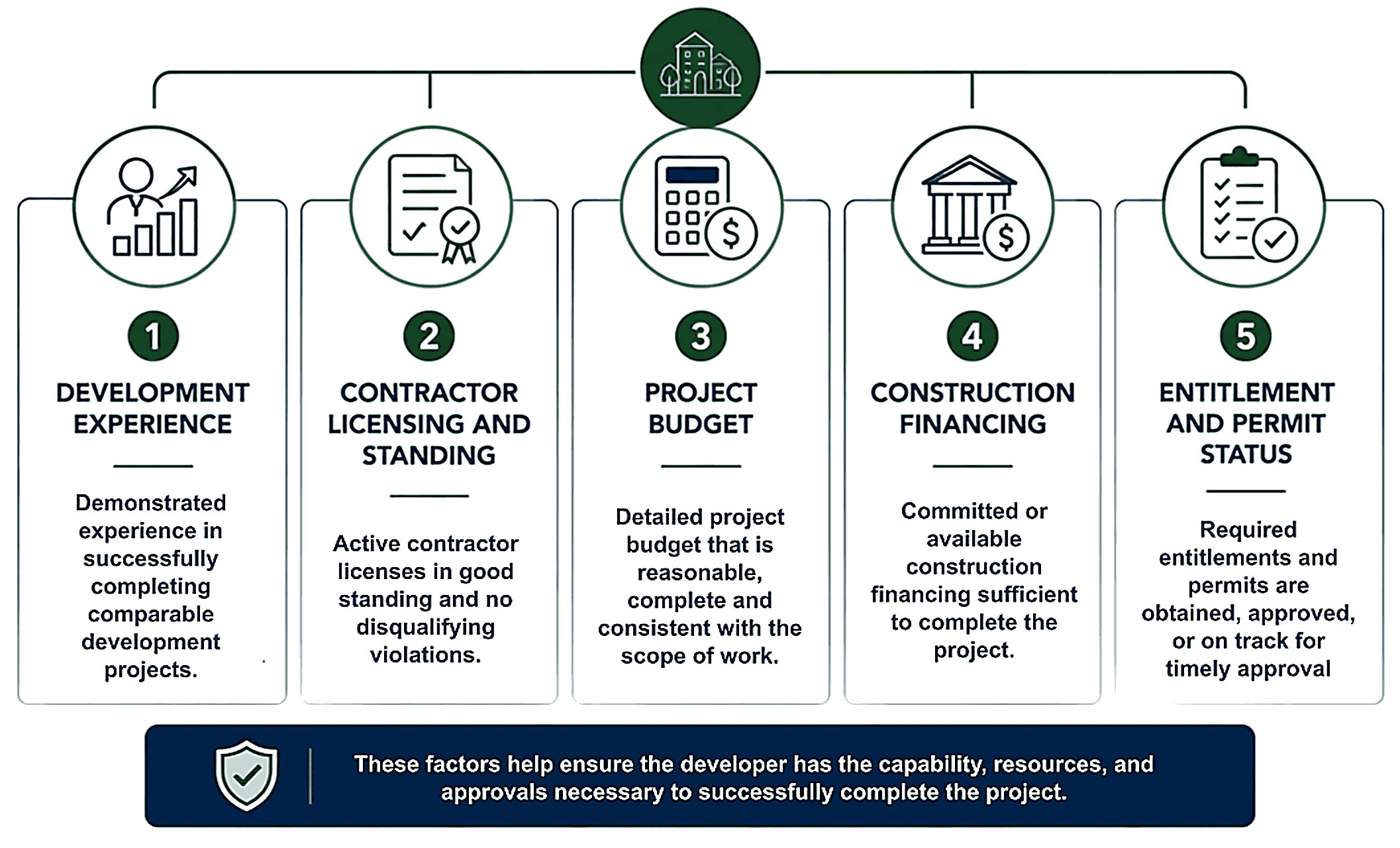
Five things, and you already know all five.
No new paperwork exists here. Every item is something your lender or your building department has already asked you for.
Two things to know before you apply.
Clear the three numbers, fit a project type, own your dirt. That's qualification.
What your fees look like through INSITE
No calculator needed. Here is the whole comparison, in the founder's own example.
Example: 10-lot residential subdivision
A developer constructing a 10-lot subdivision with approximately $250,000 of eligible public fees can have those costs paid through INSITE rather than paying them upfront.
- 10 residential lots
- $25,000 in eligible public fees per lot
- Estimated annual Special Tax: approximately $2,400 per lot
- Repayment occurs through the county property tax roll and generally transfers with the property upon sale.
The amount is secured by the property's Special Tax and paid through the county property tax roll over the term. This preserves working capital for land development and home construction while reducing reliance on higher-cost construction capital.
The day-one difference
Paying fees yourself on that project: $250,000 in cash at permit, roughly 18 months before your first closing. Through INSITE: fees we pay on your behalf at the permit counter, and your day-one cash into fees is zero. Deal costs are paid on the property tax bill.
Your project runs on your jurisdiction's posted fee schedule, not the example. School fees are excluded from the program at launch. Figures shown are founder estimates for illustration; rates and final numbers are set at term sheet.
Complete and return to HGF Management Company, or apply online through the program website.
Check what you can attach today
Missing items don't stop the application; the rest is collected during underwriting.